


The human body is a miraculous system of organs, glands, tissues, muscles, bones, and nerves, monitored and controlled by the brain, using electrical and chemical signals sent through the central nervous system and bloodstream.
Imagine the brain as the command center that monitors, regulates, and maintains stability across the body. The ability of the body to maintain stable internal balance, such as regulating body temperature or repairing the blood vessels and skin after a cut, are examples of how homeostasis is maintained.
How Does Homeostasis Work?
Maintaining homeostasis requires that the body continuously works to control itself. Therefore, every physiological condition must be monitored and measured against the normal range of values (setpoints) considered healthy and stable.
For example, your body’s optimum temperature is about 98.6 degrees Fahrenheit. If your temperature goes too far above or below this set point, changes are set into motion to restore homeostasis.
Various biological systems within the body support homeostasis. These included the Central Nervous System, Immune System, Circulatory System, Nervous System, and Endocannabinoid System.
The process that supports homeostasis is called a feedback loop.
Feedback Loop consists of the following:
- SENSORS, also known as receptors (examples: CB1/CB2 receptors), monitor physiological conditions(values) throughout the body such as temperature, blood pressure, blood sugar, etc. These values may change due to various external factors (Stimuli) such as infection, trauma, or disease.
- The brain is the body’s CONTROL CENTER. The CONTROL CENTER receives physiological signals from the body and compares these values to the normal ranges. If these value deviate from the normal range by too much, the CONTROL CENTER will activate a specific part of the body (Effectors) to regulate the condition.
These EFFECTORS are organs, tissue, cells, muscles, bones, glands, etc., that send and receive signals to and from the control center(brain). These effectors react to help heal and restore the body to normal(homeostasis). The Central Nervous System or the Circulatory System (blood) transmits these electrical and chemical signals throughout the body. (organs, cells, skin, joints, etc.)
Example of Homeostasis (Feedback Loop)
- The following simple example and diagram illustrate how the body works to achieve homeostasis following a deep cut and the threat of excessive blood loss.
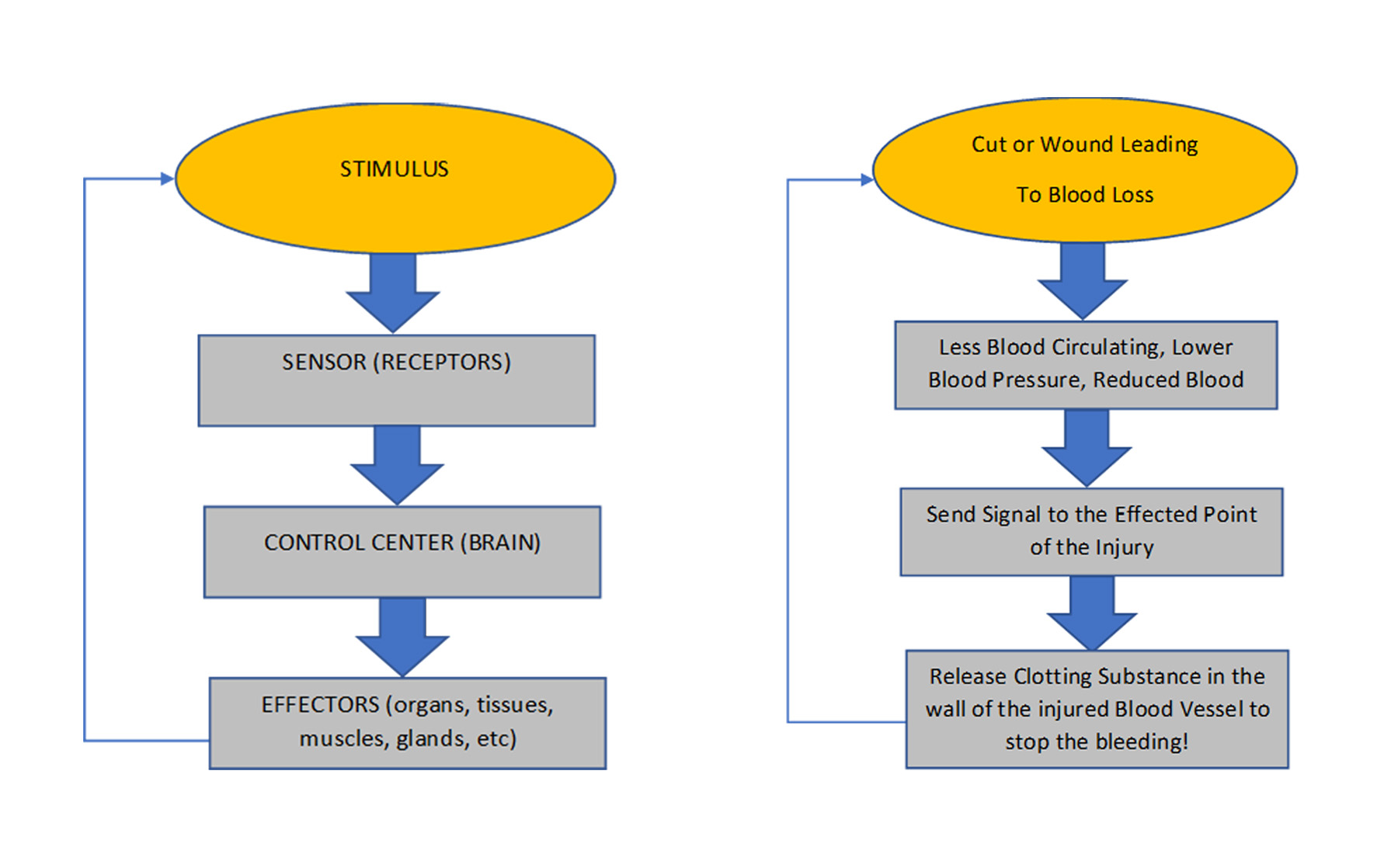
- Depending on the severity of the wound, less blood circulating will affect blood pressure and potentially reduce blood flow to the brain and other vital organs. If bleeding continues, Vital organs could shut down and lead to death.
- The body responds by releasing platelets to support the injured blood vessel wall and begins blood clotting.
- The processes and interactions involved in stopping the bleeding from a simple cut and eventually healing the wound are complicated. This simplified example demonstrates how the various systems and components of the human body work together to monitor and try to keep the body in balance (homeostasis).
- The Endocannabinoid system is one of the body’s systems that supports homeostasis. CBD is a plant-based cannabinoid that stimulates the Endocannabinoid receptors located throughout the body.
Researchers discovered CBD in 1940. It is among hundreds of compounds (phytocannabinoids) found in the cannabis plant. Today, CBD has gained significant notoriety as a natural, non-pharmaceutical option for enhancing health and wellness.
Research indicates CBD stimulates the Endocannabinoid System, promoting recovery and rebalance across the body’s biological systems.
For example, when the body becomes unbalanced due to infection, or a physical injury, the entire body works together to restore balance. This state of equilibrium is known as homeostasis.
(See What is the Homeostasis?)
How CBD and THC Affect the Endocannabinoid System
If the Endocannabinoid system detects an imbalance within the body resulting from an injury or another cause, it produces two neurotransmitters. – Anandamide (AEA) and 2-Arachidonoylglyerol (2-AG).
These neurotransmitters bind with the Endocannabinoid receptors located throughout the body. These receptors are instrumental in promoting skin, joint, bone, and muscle health, enhancing calm and sleep, reducing stiffness and soreness, revitalizing cells and tissue, and more.
Unfortunately, the two enzymes produced by the Endocannabinoid system are also responsible for the relatively quick disappearance of these cannabinoid signaling molecules. The result is the shortening of the time that AEA and 2-AG have to act on the CB1 or CB2 receptors.
CBD and THC are two of the most recognized and highly researched plant-based cannabinoids in the world. They both are naturally occurring compounds found in Cannabis Sativa (industrial Hemp or Marijuana). Both THC and CBD bind with the Endocannabinoid CB1 and CB2 receptors to regulate the body and promote better health and wellness.
THC is typically associated with Marijuana and the euphoric feeling you get from its use. In addition, THC works directly on the Endocannabinoid receptors (CB1/CB2) in the same manner as AEA. Conversely, CBD is non-psychoactive and works by inhibiting the enzymes that dissolve AEA produced naturally by the ECS. Therefore, the longer AEA is active in the body, the greater the benefits.
CBD promotes the restoration of the body and mind by affecting the Endocannabinoid system itself. CBD is a safe option that supports the bodies’ internal restorative mechanisms and provides a natural, non-pharmaceutical choice for promoting health and wellness.
MODAE’s CBD products stimulate the Endocannabinoid system to help relieve muscle and joint discomfort and enhance calm, focus, and mood.
The Endocannabinoid system (ECS) is a complex cell signaling system discovered by a team of scientists at the Hebrew University of Jerusalem while researching the effects and potential medical benefits of Cannabis.
In March of 1992, scientists isolated the first Endocannabinoid “anandamide” in the human brain. This discovery was a game-changer since it revealed that the brain produced these signaling molecules as part of the Endocannabinoid system.
It has been almost 30 years, and the research is still ongoing. However, all the finding indicates that the ECS is responsible for regulating various functions within the body. These functions include sleep, mood, appetite, memory, pleasure, energy, well-being, bone health, joint health, brain function, skin, and nerve health. Thus, the ECS helps promote health and balance across the entire body.
The Makeup of the Endocannabinoid System
Based on the current understanding of the Endocannabinoid system, it consists of the following components.
Endocannabinoids
Endocannabinoids are signaling molecules that occur naturally in the body. These molecules are created on-demand and bind to and activate the Endocannabinoid receptors (CB1/CB2) located throughout the body. These molecules are eventually broken down and disappear.
Two Endocannabinoids have been identified:
- Anandamide (AEA)
- 2-Arachidonoylglyerol (2-AG)
Endocannabinoid Receptors
Two Endocannabinoid receptors have been identified and exist throughout the body. These Endocannabinoids are produced on demand, bind to the receptors, enabling them to act in the body to restore health and balance.
The Two Endocannabinoid receptors are:
- Cannabinoid-1 (CB1) receptors- located primarily in the brain and central nervous system
- Cannabinoid-2 (CB2) receptors- found mainly in the peripherals of the body, including the immune system
Endocannabinoid Enzymes
The Endocannabinoid system produces five Enzymes. Two of these are responsible for the break-down/disappearance of the AEA and 2-AG Endocannabinoids that signal the CB receptors to start working.
- MAGL (causes the break-down of the 2-AG cannabinoid molecules)
- FAAH (causes the break-down of the AEA cannabinoid molecules)
What Effect do CBD and THC have on the Endocannabinoid System (ECS)?
CBD and THC are plant-based cannabinoids (“phytocannabinoids”) found in Cannabis. They work on the Endocannabinoid System (ECS) and the other parts of the body.
Unlike Endocannabinoids produced by the body, CBD and THC continue to work as long as they are present in the body.
THC, like AEA, binds directly to the Endocannabinoid receptors (C1/C2), causing you to feel high. However, CBD produces positive effects by indirectly stimulating the C1/C2 receptors to slow down the enzymes that break down the essential Endocannabinoid signaling molecule AEA. Thus, allowing the AEA molecules to work longer. CBD may also reduce the psychoactive effects of THC.
Cannabinoids are chemical signaling molecules produced by the Endocannabinoid system in response to the brain detecting various conditions or imbalances within the body. These molecules interact to signal the Endocannabinoid CB1 and CB2 receptors found throughout the body to start working.
This interaction between specific cannabinoids and the Endocannabinoid receptors triggers various effects and promotes health and balance throughout the body.
There are three classifications of cannabinoids. They are Endocannabinoids, phytocannabinoids, and synthetic cannabinoids.
The breakdown of each is as follows:
- Endocannabinoids
Endocannabinoids naturally occur in the body and help regulate various physiological systems, including the brain, nervous system, immune system, glands, and tissue. - Phytocannabinoids
Phytocannabinoids are compounds found in the cannabis plant—opposed to Endocannabinoids produced by the body. Researchers have identified Over one hundred twenty phytocannabinoids to date, with THC (DELTA-9) and CBD being the most noted.Below is a shortlist of the more prominent phytocannabinoids and how they affect the body as they interact with the Endocannabinoid CB1 and CB2 receptors.- CBD (cannabidiol). CBD is non-psychoactive. It doesn’t cause a “high” or other side effects like you may get from THC. CBD has gained notoriety for medicinal benefits, such as soothing joint and muscle discomfort, promoting calm, managing stressors, and promoting balance across the various organs and tissues within the body.
- THC (tetrahydrocannabinol-DELTA-9). THC (DELTA-9) is the essential psychoactive compound found in cannabis plants. It’s responsible for the “high” associated with Marijuana use. In addition, THC binds with the Endocannabinoid receptors that regulate many essential body functions.
- CBN. Cannabinol (CBN) has shown beneficial in easing some neurological conditions’ side effects and symptoms.
- THCA. Tetrahydrocannabinol acid (THCA) is similar to THC, but it doesn’t cause any psychoactive effects. Instead, it has potential benefits for helping appetite loss and nausea.
- CBG. Cannabigerol (CBG) may help promote calm, balance, and help with mood.
- THC (tetrahydrocannabinol-DELTA-8). THC(DELTA-8) occurs typically in small amounts. Delta-8 has a similar structure to THC (DELTA-9) but is generally less potent. Because the amount found in the plant is so low, THC(DELTA-8) is produced by converting CBD or THC(DELTA-9) into THC(DELTA-8) synthetically.
- Synthetic Cannabinoids
Synthetic cannabinoids are just what the name implies. They are human-made cannabinoids. Potentially mind-altering chemicals applied on dried plant matter to be smoked or sold as a liquid vaporized in e-cigarettes. Unfortunately, this form of cannabinoids has no medical value and a high potential for abuse.
As the awareness and demand for CBD continue to grow, some may still be reluctant to test its benefits.
This slow adoption of CBD in the Black community may be partly due to hemp-based CBD’s ties to its notorious cousin, Marijuana, and the cultural stigma and racially motivated penalties associated with Marijuana possession laws of the past.
But to clear up any misconceptions that may exist concerning the differences between Hemp and Marijuana, let us take a more in-depth look at these differences.
Hemp and Marijuana are both species of Cannabis Sativa. They both contain CBD and THC (DELTA-9). Because of the many similarities between these two plants, it may be worth a deeper dive to illuminate the subtle differences.
What is Hemp?
Hemp describes Cannabis Sativa harvested for industrial use. Some by-products include CBD oil, flower, food, rope, clothing, paper, housing material, and biofuels.
Hemp” is legally classified as a variety of Cannabis Sativa L that contains 0.3% or less THC (DELTA-9) content (by dry weight). As such, hemp-derived CBD products from these plants are legal under federal law.
Hemp-derived CBD products continue to gain credibility as a natural, non-pharmaceutical option for promoting health and wellness.
MODAE CBD products are all hemp-based and THC Free, providing you the benefits of CBD without the risk of having trace amounts of THC in your system from the use of our products.
What is Marijuana?
Marijuana is a class of Cannabis Sativa and contains high percentages of THC (DELTA-9). Legally any plants exceeding the 0.3% THC (DELTA-9) limit are considered Marijuana and are illegal under the Federal Controlled Substances Act (CSA).
Marijuana also contains CBD and many other phytocannabinoids. Marijuana has been bred to contain high THC (DELTA-9) levels, from 15 -45% in some strains, and is commonly associated with drug abuse.
Top Four Differences Between Hemp and Marijuana
Hemp and Marijuana are both Cannabis Sativa plants. They contain CBD, THC (DELTA-9), and other compounds that interact with the body’s Endocannabinoid receptors responsible for regulating various functions such as sleep, physical discomfort, brain functions, bone health, skin health, and more.
- Hemp and Marijuana Differences in Composition
The critical differentiator between Hemp and Marijuana is the amount of THC (DELTA-9) produced in the plant. They both can contain varying amounts of THC (DELTA-9) and CBD. THC (DELTA-9) is known to get you high. Therefore, most standard drug tests actively screened for THC (DELTA-9). Conversely, CBD is non-psychoactive and will not get you high.
Hemp products can contain up to 0.3% THC (DELTA-9) by dry weight and still be considered legal under Federal law. On the other hand, Marijuana can have up to 30% THC (DELTA-9) and is still illegal at the federal level.
Under the Farm Bill of 2018, any plant with more than 0.3% THC (DELTA-9) is classified as Marijuana and unlawful under the Federal Control Substance Act.
- Hemp and Marijuana Differences in Legality
Before 2018, the Controlled Substance Act (CSA) of 1970 classified Hemp as an illegal substance. After the signing of the 2018 Farm Bill by Donald Trump, any hemp-derived products that contained less than or equal to 0.3% THC (DELTA-9) by weight are legal.
Marijuana is still illegal under federal law. The Federal Government considers any plants that contain greater than 0.3% THC (DELTA-9) as unlawful. Therefore, if a Hemp plant exceeds this 0.3% THC (DELTA-9) limit, it is considered Marijuana.
Any CBD products derived from Marijuana are also considered illegal under the federal Control Substance Act (CSA).
The Hemp grown for MODAE premium CBD products follow strict quality control guidelines to comply with federal regulations.
At a state level, as of the 2020 election, Marijuana for adult usage is legal in 11 states plus DC and legal for medical use in 34 states. - Hemp and Marijuana Differences in Cultivation
Hemp and Marijuana are grown under varied conditions and methods, unique to the particular crop’s usage and market objectives. Once the plants reach maturity, they are picked, dried, and processed.
Marijuana is grown under controlled conditions designed to produce female plants yielding budding flowers with high THC (DELTA-9) levels.
Marijuana cultivation requires adequate spacing to reduce the risk of mold or bacteria. Typically, growers plant one marijuana plant per four square feet.
Hemp farmers plant hemp plants closer together. For example, the Hemp grown for CBD is set 40 to 60 plants per four square feet. On the other hand, Hemp, strictly grown for fiber and other industrial uses, is planted at about 100 to 120 plants per four square feet. - Hemp and Marijuana Differences in Usage
From a scientific perspective, Hemp and Marijuana are both members of the Cannabis Sativa family. However, from a legal perspective, the primary distinction between the two is the amount of THC (DELTA-9) within each.
Though Hemp and Marijuana are closely related, they have a distinctive range of usages based on their unique chemical and structural composition.
Marijuana Application/Usages
- Recreation Drug Use (legal in 11 states)
- Medical and Pharmaceutical application for the treatment of various illnesses and symptoms (Medical Marijuana is legal in 34 states)
Hemp Application/Usages
- Manufacturing paper, clothing, furnishing, fabric, rope, plastics, building materials, feedstock, and biofuels, from hemp fiber/stalks.
- Food products: cooking oil, hemp flour, and other Hemp seed-based products
- Bedding materials, absorbents, particleboard, ceiling panels, and compost are made of Stalk fibers.
- Medicinal and beauty products are derived from CBD, terpenes, and other minor phytocannabinoids extracted from hemp flowers, leaves, and biomass. Positive research regarding the benefits of CBD has made this one of the most popular drivers of hemp cultivation.
- Bio-remediation is the usage of plants to help clean up the environment. This concept is akin to the planting of trees to help clean the air. For this application, Cannabis (Industrial Hemp) extracts toxins and pollutants from the soil and groundwater. The passage of the 2018 Farm Bill has opened the way for scientists to research and use Hemp to help clean up the environment.
MODAE Health & Wellness is here to provide you with the essential information you need to make informed decisions and feel comfortable about the CBD products you select for you and your family.
Our Hemp is sourced here in the USA and cultivated using Certified Non-GMO Organic farming methods. These best practices include strict quality control guidelines across our 7-step process to CBD Excellence. These processes help you rest assured that the CBD products we offer are premium quality and safe for you and your family.
Lab Test Results are also available for each of our Premium CBD products.
Summary: How are Hemp and Marijuana Different?
Both Hemp and Marijuana are from the family of Cannabis Sativa. However, several factors separate them from a legal and cultural perspective.
Per the 2018 Farm Bill, Industrial Hemp is classified as a Cannabis Sativa L plant that does not exceed 0.3% THC (DELTA-9). Therefore, any plant or by-product of these plants is considered legal under the Federal Controlled Substance Act (CSA).
Any plants that exceed 0.3 % THC (DELTA-9) are considered Marijuana and are illegal under the CSA.
Marijuana is a classified variety of Cannabis Sativa known for its association with drug abuse and getting high. As mentioned previously, under federal law, any Hemp plant exceeding 0.3 % THC (DELTA-9) is also classified as Marijuana and is illegal at the national level.
References:
MODAE offers you the best CBD products and believes in CBD as a safe and effective option for enhancing your health, wellness, and quality of life. You may see other brands and sites making direct claims regarding CBDs’ ability to cure or treat many medical conditions. However, the FDA strictly prohibits such claims.
MODAE Health & Wellness does not make any claims regarding the use of our products as a treatment or cure for any medical conditions.
We suggest that you check with your physician if you take any medications or have any pre-existing medical conditions before using our ingestible CBD products.
The entourage effect is a commonly used term in endocannabinoid science to suggest that the combined effect of multiple compounds of the cannabis plant (Hemp) results in enhanced effectiveness, compared to each element working independently.
These synergistic effects occur with the interaction of the various phytocannabinoids, terpenes, and other compounds found in our Hemp-derived CBD products.
Bioavailability is the fraction of the CBD that reaches the bloodstream in its unchanged form.
Several factors can affect absorption rates. Some of these factors depend on the person taking the CBD, their age, digestive system integrity, overall health, gender, the amount of food in the stomach, and even the time of day.
We at MODAE formulate our CBD products using industry-leading Nano-Emulsion technology allowing absorption rates and bioavailability higher than brands that use typical CBD formulations.
Broad-Spectrum is a term for a cannabis-based formulation that implies that the product contains many plant constituents, cannabinoids, and terpenes but contains no THC.
MODAE CBD products have all trace amounts of THC removed and come with verifiable lab test results.
Trouble sleeping can be characterized by difficulty falling asleep, staying asleep, or restless sleep, resulting from stress, worry, or other conditions. This lack of sleep can affect your mood, energy level, health, job performance, and quality of life. Changes to your diet, bedtime routine, and exercise will help.
MODAE Health & Wellness does not claim that our products treat sleep disorders. However, our CBD softgels and gummies can promote calm and relaxation, which goes a long way toward a restful sleep. And our balms can help sooth sore muscles and joints, helping you sleep better.
We suggest that you check with your physician if you take any medications or have any pre-existing medical conditions, before using our ingestible CBD products.
Each MODAE CBD product purchased has a (Batch/Lot Number) printed on each product’s bottom or side.
Use the lot number to look up the Certificate of Analysis (COA/Lab Report) for your particular product.
Method 1: COA/Lab Results Look-up using the MYCBDTEST.com website
- Locate the Batch/Lot Number for your product.
- The Batch/Lot Number is a sequence of characters and numbers found on the product container’s bottom.
- The Batch/Lot Number usually starts following the first “-” but varies and could consist of letters.
- Log on to mycbdtest.com
- Enter the Batch/Slot Number to get the COA/Lab Report for your product
Example: (MODAE CBD Strawberry Gummies)
Underneath the container: S102500-20168-08:
The Batch/Lot Number = 20168-08
- Log on to mycbdtest.com.
- Type in the Batch/Lot Number to get the COA/Lab Report for your product.
Method 2: Lab Results Look-up using the MODAEwellness.com website
- Locate the Batch/Lot Number for your product.
- The Batch/Lot Number is a sequence of characters and numbers found on the product container’s bottom.
- The Batch/Lot Number usually follows the first “-” but varies and could consist of letters.
- Log on to modaewellness.com
- Navigate to the Lab Results Page
- Select the Batch/Lot Number to view the COA/Lab Results for the product
Example: (MODAE CBD Strawberry Gummies)
Underneath the container: S102500-20168-08:
The Batch/Lot Number = 20168-08
- Log on to modaewellness.com
- Navigate to the Lab Results Page
- Select the Batch/Lot Number to view the COA/Lab Results for the product